Daily Impeachment News:
September 25, 2008
BBC
Guantanamo prosecutor steps down
Col Vendeveld wanted to negotiate a plea deal, defence lawyers say
A US military prosecutor at Guantanamo Bay has resigned in what defence lawyers describe as a row over ethics.
Lt Col Darrel Vandeveld had quit because his office suppressed evidence that could have cleared a client, defence lawyer Major David Frakt said.
The chief prosecutor has confirmed the resignation, but he denied withholding any evidence.
The case involves an Afghan detainee accused of throwing a grenade at a US military jeep, injuring three people.
The prosecution is said to have withheld evidence that others had confessed to carrying out the attack.
Col Vendeveld is the fourth Guantanamo military prosecutor to quit.
Court declaration
Col Lawrence Morris, the Guantanamo military commissions chief prosecutor, told reporters that there were no grounds for Col Vandeveld’s “ethical qualms”.
“All you have is somebody who is disappointed that his superiors didn’t see the wisdom of his recommendations in the case,” Col Morris said.
Maj Frakt told reporters that Col Vandeveld had wanted to negotiate a plea deal for the detainee, but that his superiors had blocked this.
Col Vandeveld has not commented publically, but made his concerns known in an declaration to the military court at Guantanamo Bay.
Q&A: Guantanamo tribunals
The declaration can only be made public by a tribunal judge, but in a copy obtained by the Associated Press news agency, Col Vandeveld wrote that “potentially exculpatory evidence has not been provided”.
He blamed this on a failure by “prosecutors and officers of the court”.
Col Vandeveld was prosecuting Mohammed Jawad, 24, who is accused of tossing a grenade into a military jeep at a bazaar in Kabul in 2002, injuring two US soldiers and their Afghan interpreter.
Col Vandeveld said prosecutors knew that Mr Jawad might have been drugged before the attack, and that the Afghan interior ministry said two other men had confessed to the same crime.
He also expressed concerns over Mr Jawad’s treatment.
“As a juvenile at the time of his capture, Jawad should have been segregated from the adult detainees, and some serious attempt made to rehabilitate him,” Col Vandeveld wrote in his declaration.
“I am bothered by the fact that this was not done.”
In August, a military judge ruling barred the tribunal’s legal adviser, Air Force Brig Gen Thomas Hartmann, from Mr Jawad’s case, accusing him of having compromised his objectivity.
Brig Gen Hartmann allegedly “pushed” for Mr Jawad to be charged because of the “gripping” details of his case.
The judge, Col Steve Henley, said that Brig Gen Hartmann’s public statements aligning himself with prosecutors and defending the Pentagon’s system for prosecuting terror suspects had compromised his objectivity.
(Source)
|
June 14, 2008
Editor & Publisher
By E&P Staff
NEW YORK – With George W. Bush visiting Germany and other parts of Europe this week, German newspapers have been slamming the U.S. president in language stronger than most American dailies use.
The Der Spiegel publication compiled some of the comments, which are quoted below.
– Berliner Zeitung: “Rarely has an American president been less popular in this country. And rarely has one embodied the arrogance of power more convincingly than Bush.
“It is unforgotten how he humiliated the United Nations, how he went to war against Iraq with a ‘Coalition of the Willing,’ how his closest aides portrayed France and Germany as wimps. Bush discredited values which had brought United States worldwide respect. Many have lost faith in America because of the false reasons given for the war, the unlawful imprisonment of terror suspects in Guantanamo, or the photos of Abu Ghraib.”
– Handelsblatt: “Bush junior wasn’t up to the challenge following the attacks of Sept. 11, 2001, because he let himself be pushed into an unwarranted war by listening to the wrong advisers, and thereby prevented a broad front against terrorism. Constructive Middle East policy was made more difficult, and the regime in Iran was strengthened. Bush didn’t just boycott the Kyoto Protocol, he persistently undermined it — and thereby helped polluters such as China. With this unilateralism Bush damaged America’s reputation and curtailed his room for maneuver.”
– Suddeutsche Zeitung: “In Germany, America is no longer seen as a country of individual liberty, as a reliable ally, and definitely not as a model. There are a large number of justified accusations leveled at Bush’s policies. They include dangerous naivete, lies, and the sustained infringement of human rights.
“Bush won’t care, but in the thoughts and feeling of many Germans he is leaving behind a mixture of antipathy, ridicule, anger, and skepticism towards U.S. policies and towards America in general. Differentiating between the two has become more difficult with every year of his presidency. The memory of Bush will darken America’s image in the world for years to come.”
– The conservative Die Welt went easier on Bush, though it did criticize him a little. Its comments: “George W. Bush and his government made mistakes. The biggest was to think that democracy could be exported with a guarantee of success. But those who see George W. Bush as having stepped outside the boundaries of Western constitutional values ignore two things: Firstly, the United States really was attacked on Sept. 11, 2001, not Germany or France. The U.S. has good reasons to respond decisively to that. And secondly, it’s not as though much-praised multilateralism would have made the world a much safer place. Often it was merely an excuse for staying out of trouble and quietly relying on the U.S. to be there when things got serious.
“It’s not just George W. Bush who’s unwelcome. Ever since Reagan’s Berlin visit in 1987, American presidents haven’t been especially welcome whenever they embodied the uncomfortable aspect of the Atlantic alliance, which many regard as a burden that should be discarded soon. But the Bush critics are overlooking one thing: Whether Obama or McCain, the coming president of the U.S. will be a difficult partner.”
E&P Staff (letters@editorandpublisher.com)
(Original Article)
|
June 6, 2008
By Dan Williams
JERUSALEM (Reuters) – An Israeli attack on Iranian nuclear sites looks “unavoidable” given the apparent failure of sanctions to deny Tehran technology with bomb-making potential, one of Prime Minister Ehud Olmert’s deputies said on Friday.
“If Iran continues with its program for developing nuclear weapons, we will attack it. The sanctions are ineffective,” Transport Minister Shaul Mofaz told the mass-circulation Yedioth Ahronoth newspaper.
“Attacking Iran, in order to stop its nuclear plans, will be unavoidable,” said the former army chief who has also been defense minister.
It was the most explicit threat yet against Iran from a member of Olmert’s government, which, like the Bush administration, has preferred to hint at force as a last resort should U.N. Security Council sanctions be deemed a dead end.
Iran has defied Western pressure to abandon its uranium enrichment projects, which it says are for peaceful electricity generation rather than bomb-building. The leadership in Tehran has also threatened to retaliate against Israel — believed to have the Middle East’s only atomic arsenal — and U.S. targets in the Gulf for any attack on Iran.
Mofaz also said in the interview that Iranian President Mahmoud Ahmadinejad, who has called for Israel to be wiped off the map, “would disappear before Israel does.”
A spokesman for Prime Minister Ehud Olmert did not address Mofaz’s comments directly but said that “all options must remain on the table” and said more could be done to put financial pressure on Tehran.
“Israel believes strongly that while the U.N. sanctions are positive, much more needs to be done to pressure the regime in Tehran to cease its aggressive nuclear program,” spokesman Mark Regev said.
“We believe the international community should be considering further tangible steps such as embargoing refined petroleum headed for Iran, sanctions against Iranian businessmen traveling abroad, tightening the pressure on Iranian financial institutions and other such steps,” he added.
Mofaz’s remarks came as he and several other senior members of Olmert’s Kadima Party prepare for a possible run for top office should a corruption scandal force the Israeli prime minister to step down.
Iranian-born Mofaz has been a main party rival of the Israeli prime minister, particularly following the 2006 elections when Olmert was forced to hand the defense portfolio to Labour, his main coalition partner, at Mofaz’s expense.
Mofaz, who is also designated as a deputy prime minister, has remained privy to Israel’s defense planning. He is a member of Olmert’s security cabinet and leads regular strategic coordination talks with the U.S. State Department.
Israeli planes destroyed Iraq’s nuclear reactor in 1981.
A similar Israeli sortie over Syria last September razed what the U.S. administration said was a nascent nuclear reactor built with North Korean help. Syria denied having any such facility.
Independent analysts have questioned, however, whether Israel’s armed forces can take on Iran alone, as its nuclear sites are numerous, distant and well-fortified.
(Additional reporting by Ori Lewis; Editing by Dominic Evans)
(Original Source)
|
June 2, 2008
The Guardian
– Report says 17 boats used
– MPs seek details of UK role
– Europe attacks 42-day plan
Duncan Campbell and Richard Norton-Taylor
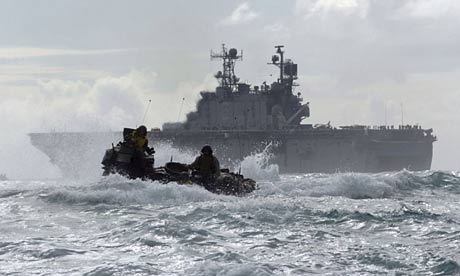
An amphibious assault vehicle leaves the USS Peleliu, which was used to detain prisoners, according to the human rights group Reprieve.
The United States is operating “floating prisons” to house those arrested in its war on terror, according to human rights lawyers, who claim there has been an attempt to conceal the numbers and whereabouts of detainees.
Details of ships where detainees have been held and sites allegedly being used in countries across the world have been compiled as the debate over detention without trial intensifies on both sides of the Atlantic. The US government was yesterday urged to list the names and whereabouts of all those detained.
Information about the operation of prison ships has emerged through a number of sources, including statements from the US military, the Council of Europe and related parliamentary bodies, and the testimonies of prisoners.
The analysis, due to be published this year by the human rights organisation Reprieve, also claims there have been more than 200 new cases of rendition since 2006, when President George Bush declared that the practice had stopped.
It is the use of ships to detain prisoners, however, that is raising fresh concern and demands for inquiries in Britain and the US.
According to research carried out by Reprieve, the US may have used as many as 17 ships as “floating prisons” since 2001. Detainees are interrogated aboard the vessels and then rendered to other, often undisclosed, locations, it is claimed.
Ships that are understood to have held prisoners include the USS Bataan and USS Peleliu. A further 15 ships are suspected of having operated around the British territory of Diego Garcia in the Indian Ocean, which has been used as a military base by the UK and the Americans.
Reprieve will raise particular concerns over the activities of the USS Ashland and the time it spent off Somalia in early 2007 conducting maritime security operations in an effort to capture al-Qaida terrorists.
At this time many people were abducted by Somali, Kenyan and Ethiopian forces in a systematic operation involving regular interrogations by individuals believed to be members of the FBI and CIA. Ultimately more than 100 individuals were “disappeared” to prisons in locations including Kenya, Somalia, Ethiopia, Djibouti and Guantánamo Bay.
Reprieve believes prisoners may have also been held for interrogation on the USS Ashland and other ships in the Gulf of Aden during this time.
The Reprieve study includes the account of a prisoner released from Guantánamo Bay, who described a fellow inmate’s story of detention on an amphibious assault ship. “One of my fellow prisoners in Guantánamo was at sea on an American ship with about 50 others before coming to Guantánamo … he was in the cage next to me. He told me that there were about 50 other people on the ship. They were all closed off in the bottom of the ship. The prisoner commented to me that it was like something you see on TV. The people held on the ship were beaten even more severely than in Guantánamo.”
Clive Stafford Smith, Reprieve’s legal director, said: “They choose ships to try to keep their misconduct as far as possible from the prying eyes of the media and lawyers. We will eventually reunite these ghost prisoners with their legal rights.
“By its own admission, the US government is currently detaining at least 26,000 people without trial in secret prisons, and information suggests up to 80,000 have been ‘through the system’ since 2001. The US government must show a commitment to rights and basic humanity by immediately revealing who these people are, where they are, and what has been done to them.”
Andrew Tyrie, the Conservative MP who chairs the all-party parliamentary group on extraordinary rendition, called for the US and UK governments to come clean over the holding of detainees.
“Little by little, the truth is coming out on extraordinary rendition. The rest will come, in time. Better for governments to be candid now, rather than later. Greater transparency will provide increased confidence that President Bush’s departure from justice and the rule of law in the aftermath of September 11 is being reversed, and can help to win back the confidence of moderate Muslim communities, whose support is crucial in tackling dangerous extremism.”
The Liberal Democrat’s foreign affairs spokesman, Edward Davey, said: “If the Bush administration is using British territories to aid and abet illegal state abduction, it would amount to a huge breach of trust with the British government. Ministers must make absolutely clear that they would not support such illegal activity, either directly or indirectly.”
A US navy spokesman, Commander Jeffrey Gordon, told the Guardian: “There are no detention facilities on US navy ships.” However, he added that it was a matter of public record that some individuals had been put on ships “for a few days” during what he called the initial days of detention. He declined to comment on reports that US naval vessels stationed in or near Diego Garcia had been used as “prison ships”.
The Foreign Office referred to David Miliband’s statement last February admitting to MPs that, despite previous assurances to the contrary, US rendition flights had twice landed on Diego Garcia. He said he had asked his officials to compile a list of all flights on which rendition had been alleged.
CIA “black sites” are also believed to have operated in Thailand, Afghanistan, Poland and Romania.
In addition, numerous prisoners have been “extraordinarily rendered” to US allies and are alleged to have been tortured in secret prisons in countries such as Syria, Jordan, Morocco and Egypt.
(Original Source)
|
June 1, 2008
telegraph.co.uk
John Bolton escapes citizen’s arrest at Hay Festival
By Stephen Adams, Arts Correspondent
John Bolton, the former US ambassador to the United Nations, has escaped an attempted citizen’s arrest as he appeared at the Hay Festival.
Security guards blocked the path of columnist and activist George Monbiot, who tried to make the arrest as Mr Bolton left the stage.
The former ambassador – a key advisor to President George W Bush who argued strongly in favour of invading Iraq – had been giving a talk on international relations to more than 600 people at the literary festival.
Mr Monbiot was blocked by two heavily-built security guards at the end of the one-and-a-half hour appearance, before he could serve a “charge sheet” on him.
After being released by the guards the columnist – a fierce critic of the 2003 American-led invasion – made a dash through the rain-soaked tented village in a failed attempt to catch up with Mr Bolton.
A crowd of about 20 protestors, one dressed in a latex George Bush mask, chanted “war criminal” as Mr Bolton was ushered away.
Mr Monbiot said moments later he was “disappointed” that he had been blocked from making the citizen’s arrest.
“This was a serious attempt to bring one of the perpetrators of the Iraq war to justice, for what is described under the Nuremberg Principles as an international crime,” he said.
During Mr Bolton’s talk, to a packed-out audience, Mr Monbiot had asked Mr Bolton what difference there was between him and a Nazi war criminal.
Mr Bolton said the war was legal, partly because Iraq had failed to comply with a key and binding UN resolution after the end of the Gulf War in 1991.
On the war’s legality, he added: “This is not my personal opinion, this is the opinion of the entire legal apparatus of the US government.”
A citizen’s arrest can be carried out under certain circumstances by a member of the public, if they believe a person had carried out a crime, under the Serious and Organised Crime and Police Act 2005.
Earlier, festival director Peter Florence had said they had sought legal advice and been told carrying out such an arrest would be “completely unlawful” given the circumstances.
He said: “”The Hay Festival encourages visitors to voice their opinions, but also requires that, in their expression, they respect both the law and the speaker.”
A spokesman for The Guardian, for which Mr Monbiot writes a regular column, said he was acting in a “personal capacity”.
(Original Source)
|
Next Page »
"I just want you to know that,
when we talk about war, we're really talking about peace."
-Bush, June 18, 2002
"War is Peace"
-Big Brother in George Orwell's 1984

|